
OUR GREAT MINDS
For decades, Newfoundland and Labrador has been defined by energy. Not in theory, but in practice. Offshore oil built industries, created jobs, and positioned the province as a serious contributor to Canada’s economic strength. It proved something important—that this place is capable of executing large-scale, complex, high-value projects on the global stage.
But what is happening now is not the end of that story. It is the beginning of a more powerful one.
Because the conversation around energy is changing, and with it comes a decision point. Some regions will retreat, scale back, and slowly fade from relevance. Others will recognize the shift for what it is—not a threat, but an expansion of opportunity. Newfoundland and Labrador is uniquely positioned to be in the second group.
The mistake many make is thinking in terms of replacement. Oil versus renewables. Old versus new. As if one must disappear for the other to succeed. That thinking is small, and it misses the real opportunity entirely. The future of energy is not about abandoning what works. It is about building on it, extending it, and integrating it into something more advanced, more resilient, and more strategic.
This province already has what most places are still trying to build. It has deep-water access, proven offshore expertise, a workforce that understands complex industrial environments, and a track record of delivering under extreme conditions. Those are not relics of the past. They are assets for the future.
The next era of energy will not be defined by a single source. It will be defined by systems. Oil, hydro, wind, hydrogen, and emerging technologies will not operate in isolation. They will operate together, feeding into broader energy networks that demand reliability, scale, and adaptability. Newfoundland and Labrador has the potential to become a place where that integration happens in a real, functional way.
Offshore oil remains a critical part of that equation. Not just economically, but strategically. The world is not moving away from oil overnight, no matter how strong the narrative suggests. Demand remains high, and jurisdictions that can produce responsibly, efficiently, and at scale will continue to play a central role. Newfoundland and Labrador has already demonstrated that capability. The opportunity now is to leverage that foundation to support what comes next.
Hydroelectric power is one of the province’s most powerful advantages, and one that is often underappreciated. It provides stable, large-scale, low-emission energy that can support not just local needs, but industrial expansion. In a world where energy-intensive industries are looking for reliable and cleaner power sources, that becomes a competitive edge. It allows Newfoundland and Labrador to attract operations that require significant energy input, including data centers, processing facilities, and advanced manufacturing.
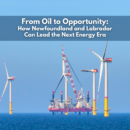
Wind energy is also emerging as a major opportunity, particularly in offshore environments where conditions are among the strongest in North America. But the real value is not just in generating electricity. It is in what that electricity can enable. One of the most talked-about opportunities is hydrogen production, where excess or dedicated renewable energy can be used to produce fuel that is transportable, scalable, and increasingly in demand globally. If developed strategically, this could position the province not just as an energy producer, but as an energy exporter in new forms.
What ties all of this together is infrastructure and vision. Without coordination, these opportunities remain separate. With the right approach, they become a system. Offshore platforms, transmission capacity, ports, processing facilities, and export channels can be aligned to support multiple energy streams rather than a single one. That is where the real shift happens—from industry to ecosystem.
There is also a significant opportunity in what happens beyond extraction and generation. Too often, value leaves at the point of export. Resources are shipped out, processed elsewhere, and sold back at a premium. The next energy era will reward regions that move further up the value chain. That means refining, processing, manufacturing, and developing technologies locally. It means creating not just energy, but products, systems, and expertise that can be sold to the world.
This is where business opportunity expands rapidly.
Companies that understand fabrication, engineering, logistics, and industrial systems can transition into new energy projects without starting from zero. The same capabilities used to build offshore platforms can be adapted to build wind infrastructure. The same supply chains that support oil operations can support hydrogen development. The same workforce can be retrained, upgraded, and expanded to meet new demands.
This is not a reinvention. It is an evolution.
There is also a global context that cannot be ignored. Energy security is becoming one of the defining issues of our time. Nations are looking for stable, reliable partners who can supply energy in multiple forms. Canada has the advantage of political stability, natural resources, and geographic positioning. Newfoundland and Labrador strengthens that advantage through its Atlantic access and proximity to international shipping routes. That creates an opening to become not just a regional player, but a contributor to global energy systems.
At the same time, this transition will require leadership that is willing to think long-term. The greatest risk is not in moving forward. It is in hesitating, in trying to preserve the past without building the future. The jurisdictions that succeed will be the ones that recognize that energy is not static. It evolves. And those who evolve with it do not lose relevance. They expand it.
For entrepreneurs, investors, and business leaders, this moment matters. The shift toward integrated energy systems will create demand across multiple sectors at once. Construction, engineering, transportation, manufacturing, technology, and training will all be part of the growth. The question is not whether opportunity exists. It is where and how to position within it.
What makes Newfoundland and Labrador different is that it does not need to start from scratch. It already has credibility in energy. It already understands scale. It already knows how to operate in difficult environments. Those strengths, combined with emerging opportunities in renewables and energy innovation, create a rare alignment. This is how regions move from relevance to leadership. Not by abandoning what built them, but by using it as a foundation for what comes next.
The next energy era will not belong to those who choose one path over another. It will belong to those who can connect them. Those who can build systems instead of silos. Those who can see beyond the immediate debate and recognize the long-term shift.
Newfoundland and Labrador has that opportunity now. Not to step away from energy, but to step into a larger version of it. And for those paying attention, this is not just a provincial story. It is a blueprint for what comes next.
Did you enjoy this article?
You May Also Enjoy...
 Bull Arm: Canada’s $200M Move That Could Reshape the Economy
 Bay du Nord: A $21 Billion Opportunity for Industry and Local Business Growth
 Energy NL Reacts to Budget 2023 – Welcomes Support for Energy Sector
 Aker Solutions Appoints Trine Svalestad
 Wood to Power Europe’s Green Revolution with Massive Offshore Wind Connection Project







We respect your privacy and will never share your information with third parties.