OUR GREAT MINDS
OUR GREAT MINDS
There is a race happening right now, and most people are not paying attention to it. It is not being fought with headlines or public debate. It is being fought through land acquisition, exploration rights, supply chain agreements, and quiet strategic investments. It is a race for control over the materials that will power the next generation of global industry. Lithium. Nickel. Cobalt. Graphite. Rare earth elements. These are no longer just commodities. They are leverage. And Canada is sitting on one of the most important untapped advantages in the world.
For years, the conversation around energy has focused on production—oil, gas, electricity. But what is becoming increasingly clear is that the future of energy does not begin at the point of generation. It begins at the point of extraction. Without critical minerals, there are no batteries. Without batteries, there is no large-scale electrification. And without electrification, the entire transition narrative collapses. This is where the opportunity becomes undeniable.
Canada holds significant reserves of many of these critical minerals, particularly in provinces like Ontario, Quebec, and Newfoundland and Labrador. The geology is there. The stability is there. The access to global markets is there. What has been missing is urgency and coordination. That is starting to change.
Around the world, nations are waking up to a simple reality. Dependence on external supply chains for critical materials is a strategic risk. The current global system is heavily concentrated, with a small number of countries controlling large portions of mining, processing, and refining. That concentration creates vulnerability. It creates exposure. And it creates a scramble among other nations to secure their own supply. Canada is now part of that shift. But this is not just about mining more materials. That is where many will misunderstand the opportunity. Extraction is only the first layer. The real value, the real leverage, and the real long-term wealth are created further along the chain—in processing, refining, and manufacturing.
Right now, much of the world still ships raw materials out and buys finished products back at a premium. That model benefits those who control the middle and final stages. If Canada simply increases extraction without building out processing capacity, it will capture only a fraction of the value available. The next phase must be different.
The opportunity is to build a full-spectrum ecosystem. Mining, refining, battery production, advanced materials, and recycling. Each layer adds value. Each layer creates jobs. Each layer strengthens economic independence. And each layer reduces reliance on external systems that may not always align with national interests. This is where business opportunity expands rapidly.
Exploration companies will move first, identifying and securing deposits. Mining operations will follow, requiring capital, equipment, engineering, and logistics. But beyond that, there is a much larger wave forming. Processing facilities will be needed to convert raw materials into usable forms. Manufacturing plants will be required to produce battery components and related technologies. Transportation networks will need to adapt to move materials efficiently across regions and toward export points.
And then there is technology.
Modern mining is no longer just physical. It is increasingly driven by data, automation, environmental monitoring, and efficiency systems. Companies that can bring innovation into this space will not only support the industry. They will redefine it. From AI-driven exploration to automated extraction systems, the integration of technology into resource development is becoming a competitive advantage.
There is also a growing emphasis on sustainability, but not in the abstract sense that often dominates public conversation. In practical terms, sustainability is about efficiency, reduced waste, responsible extraction, and long-term viability. Companies that can operate with higher environmental standards while maintaining profitability will be the ones that secure long-term contracts and partnerships. This is not about optics. It is about meeting the expectations of global markets that are becoming more selective about where they source materials.
For Newfoundland and Labrador, the opportunity is particularly compelling. The province already has a strong foundation in resource development and industrial operations. It understands scale. It understands logistics. It understands how to operate in challenging environments. These are not minor advantages. They are exactly the capabilities required to participate in the next phase of mineral development.
But the opportunity is not limited to large corporations. Entrepreneurs, service providers, and smaller firms have a role to play across every stage of the ecosystem. Equipment supply, transportation, environmental services, workforce training, data systems, maintenance, and support operations all represent entry points into a growing industry. The companies that position themselves early, build relationships, and develop specialized capabilities will be the ones that benefit most as the sector expands.
There is also a geopolitical layer that cannot be ignored. Critical minerals are becoming a central component of international strategy. Nations are forming alliances, securing supply agreements, and investing in foreign assets to ensure access. Canada, with its political stability and resource base, is seen as a reliable partner. That creates an opportunity to attract international investment, but it also requires careful thinking about how much control is retained domestically. Because this is not just about economics. It is about sovereignty.
Control over critical minerals means control over the materials that power industries, technologies, and defense systems. It means influence in global negotiations. It means resilience in times of disruption. And it means the ability to shape the future rather than react to it. The mistake would be to treat this as a temporary boom. This is not a cycle. It is a shift.
The demand for these materials is not driven by speculation. It is driven by structural change in how the world builds, powers, and moves. That demand is expected to grow for decades, not years. And the regions that position themselves now will carry that advantage forward over time. The question is not whether Canada has the resources. It does. The question is whether it has the vision to fully develop them. Because there is a difference between participating in a market and leading it. Participation generates revenue. Leadership generates influence, stability, and long-term growth.
Canada has the opportunity to lead. Not by simply extracting more, but by building an integrated system that captures value at every stage. Not by reacting to global demand, but by positioning itself as an essential part of the supply chain. Not by thinking in terms of short-term projects, but by building long-term capability.
This is one of the clearest opportunities of our time. It is not loud. It is not obvious to everyone. But it is already underway. And the ones who understand it early will not just benefit from it. They will help shape it.
Did you enjoy this article?
You May Also Enjoy...
 Global exploration budget for metals jumps 35% year-on-year to $11.2 billion
 Wärtsilä Power Plant Upgrade & Extension Will Enable Production Expansion
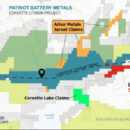 Arbor Metals Welcomes Additional Signs of Support for Quebec Lithium Industry
 Decoding Uranium: Unveiling the Power Behind Sustainable Energy
 Independent Preliminary Economic Assessment For Atlas Salt’s Great Atlantic Project