
OUR GREAT MINDS
OUR GREAT MINDS
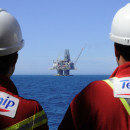
 Bay du Nord is a series of offshore oil discoveries located in the Flemish Pass Basin, approximately 475 kilometres northeast of St. John’s, Newfoundland and Labrador, in water depths ranging from 621 to 1,200 metres. It is being developed by Equinor Canada Ltd. (operator, 65% interest in the Bay du Nord field) and BP Canada Energy Group ULC (35%), and will be Canada’s first deepwater oil project.
Discovered in 2013, the project encompasses five offshore fields: Bay du Nord, Cambriol, Cappahayden, Harpoon, and Baccalieu. The initial development phase focuses on Bay du Nord and Cambriol, which together hold estimated recoverable resources of 429 million barrels of oil — Bay du Nord contributing 237 million barrels and Cambriol contributing 192 million barrels. At peak production, the facility will process approximately 160,000 barrels of oil per day, with a potential debottlenecked capacity of up to 175,000 barrels per day.
The production installation will be a Floating Production, Storage, and Offloading (FPSO) vessel — a ship-shaped facility with a disconnectable turret, designed to process, store, and offload crude oil to shuttle tankers. The FPSO will carry approximately 1.2 million barrels of oil storage capacity. It will be ice-strengthened and engineered for year-round operations in the sub-Arctic conditions of the Flemish Pass.

According to Equinor’s Benefits Plan filed with the C-NLOER, the initial phase of the project is expected to deliver the following to Newfoundland and Labrador:

The deal surpasses what was negotiated in 2018. It is the first life-of-field benefits agreement ever signed for an offshore oil and gas project in the province — commitments that run for the entirety of the project’s productive life, not just the construction years.
The March 3, 2026, Benefits Agreement is historic in its scope and detail. Key commitments include:
• 95% in-province fabrication of all subsea components.
• Apprenticeship employment targets — first ever in an NL offshore agreement: minimum 10% of skilled
trades hours in development, 15% during operations.
• Provincial equity option — giving the Government of NL a share in the project’s future growth.
• First-consideration provisions for NL residents (employment) and NL businesses (procurement) —
cascading contractually to all Tier 1 contractors and subcontractors.
• Integrated Operations Centre (IOC) in the St. John’s area staffed by Equinor and FPSO contractor personnel for the life of the project.
• 1.9 million person-hours of professional services work to be performed in the province.
On May 5, 2026, Equinor submitted its formal Development Plan Application (DPA) to the Canada-Newfoundland and Labrador Offshore Energy Regulator (C-NLOER). The C-NLOER board will determine whether the development is in the public interest. The application will ultimately be reviewed and approved by the federal Natural Resources Minister and the provincial Energy Minister. The public will have a formal opportunity to provide input before those decisions are made.
C-NLOER staff had already completed significant preparatory work before the application was received — including pre-engagement technical sessions, subsurface workshops, and early assessment of Equinor’s geoscience and engineering models.
The environmental question has already been settled by the 2022 federal EA, backed by 137 legally binding conditions enforced by the C-NLOER for the life of the project. The Benefits Agreement is a separate provincial process and is not subject to the C-NLOER public review.
Equinor evaluated six possible development concepts — FPSO, Gravity Based Structure (GBS), Tension-Leg Platform (TLP), semi-submersible, spar with storage, and spar without storage — and selected the FPSO as the only technically and economically feasible option. The deciding factors: water depths up to 1,200 metres, 475 km from shore, the need to disconnect in the event of icebergs or extreme weather, and the requirement for on-board crude storage and shuttle tanker offloading.

 The Business Opportunity: A Province-Wide Supply Chain
Bay du Nord represents the largest supply chain opportunity for Newfoundland and Labrador since Hebron, and its local content commitments go further than any previous offshore project. Here is a breakdown of opportunities by sector.
 Subsea and Structural Fabrication
The commitment to fabricate 95% of subsea components in Newfoundland and Labrador is the most direct mandate for the provincial fabrication sector. Equinor has conducted facility tours across the province to assess local capacity. Named facilities in Equinor’s Benefits Plan:
 Additional local fabricators listed in Equinor’s plan include: Acuren Group, Ameil Constructors, Atlantic Hydraulic & Machine, Bursey Manufacturing, C&W Offshore, Compass Limited, Green Infrastructure Partners Atlantic, and RothLockston.
Approximately 3.4 million person-hours of drilling and completions work will be performed in NL. Services required include (but are not limited to):
• Directional drilling, logging-while-drilling (LWD), measurement-while-drilling (MWD), mudlogging
• Cementing, wireline, coring, liner hanger services, completions equipment
• Oil Country Tubular Goods (OCTG) supply and tubular management
• Helicopter passenger and Search and Rescue (SAR) services
• Offshore supply vessels (OSV), standby vessels (SBV)
• Supply base services, customs and freight forwarding, fuel
• Waste management, weather forecasting, ice reconnaissance
• Medical services, accommodation, and telecommunications
Once production begins in 2031, Bay du Nord enters a 20-year operations phase. Estimated operations employment:
Equinor has a 20-year track record of funding NL research, and will expand its St. John’s R&D centre for the project. Technology themes directly relevant to local companies:
• Additive manufacturing and 3D printing
• Automated and autonomous inspection systems (IMR technologies, ROV/AUV)
• Digital twins and lifecycle simulators
• Robotics and drones for offshore use
• Artificial intelligence and machine learning
• Environmental monitoring technologies
• Ice management engineering and harsh environment research
• Remote operations and integrated operations support
• Advanced maritime and ocean technologies
Companies already funded by Equinor in NL include C-CORE, Kraken Robotics, Rutter, Fugro, the National Research Council, and others. Equinor is a member of ERINL and actively participates in Canada’s Ocean Supercluster.

For businesses seeking to work on Bay du Nord, the standard procurement process is:
• 1. Expression of Interest (EOI) — Equinor and Tier 1 contractors publish EOIs for upcoming contracts and procurement forecasts on project-specific websites.
• 2. Pre-qualification — Suppliers demonstrate relevant capability, safety records, and compliance with the Accord Acts.
• 3. Request for Proposal (RFP) and evaluation — Evaluated on best value: Canada-NL benefits alongside commerciality, delivery, schedule, quality, and HSE.
• 4. Contract award — Awards are publicly communicated for transparency.
All major bid submissions require completion of a local content questionnaire identifying how the bidder will support NL and Canadian suppliers, including technology transfer, training, alliances, and joint ventures. Non-provincial suppliers are encouraged to establish operations in the province and form joint ventures with local companies.
Equinor’s procurement and contract management function is based in St. John’s. BW Offshore has already opened a St. John’s office. The Subsea Integration Alliance is also required to maintain an in-province presence.
Monitor: Energy NL, TechNL, Econext, the NL Board of Trade, Equinor’s project website, and contractor websites for upcoming procurement opportunities.
An independent labour capacity assessment (Stantec Consulting Ltd., 2025) commissioned by Equinor concluded that Newfoundland and Labrador has the necessary labour force, professional expertise, and fabrication infrastructure to support the construction and operation of Bay du Nord. PEGNL currently represents more than 5,000 members with 631 registered firms — 40% based in the province.
The assessment identified areas where the province will need to grow capacity, including certain hard-to-recruit drilling and marine positions: drillers, toolpushers, OIMs, marine electricians, hydraulic technicians, and offshore crane operators with Stage 3 certification. Equinor says it is well-positioned to respond through workforce development and the transfer of global experience.
For businesses assessing whether to build or expand capacity, major onshore fabrication begins in 2027. Drilling commences ~2029. Operations begin in 2031. The timeline offers meaningful lead time for workforce and capability development now.
Bay du Nord is not just Newfoundland and Labrador’s next offshore project — it is the province’s most structurally significant economic opportunity since Hibernia. A $14 billion capital investment. $44 billion in projected provincial GDP. Up to $6.4 billion in direct government revenue. Thirty-one million person-hours of work. A new floating dry dock. A $275 million innovation and training investment. And a life-of-field commitment that runs not just for the construction years, but for two decades of production.
For the province’s fabricators, engineers, tradespeople, logistics operators, marine services companies, technology firms, and post-secondary institutions — the window is open, and the clock is running toward 2027’s Final Investment Decision. The companies that engage now, build relationships with Equinor and the Tier 1 contractors, pre-qualify early, and position themselves in the supply chain will be best placed to capture that work.
It’s a good deal. It’s a good day, and the sun is shining, offshore Newfoundland!
Did you enjoy this article?







 EnviroMed Detection Services
 Blackline Safety Secures $2.7 Million Contract, Disrupting Industry with Cutting-Edge Safety Technology
 A Committment to Being a World Leader in Health, Safety and the Environment
 Schmitz Mittz